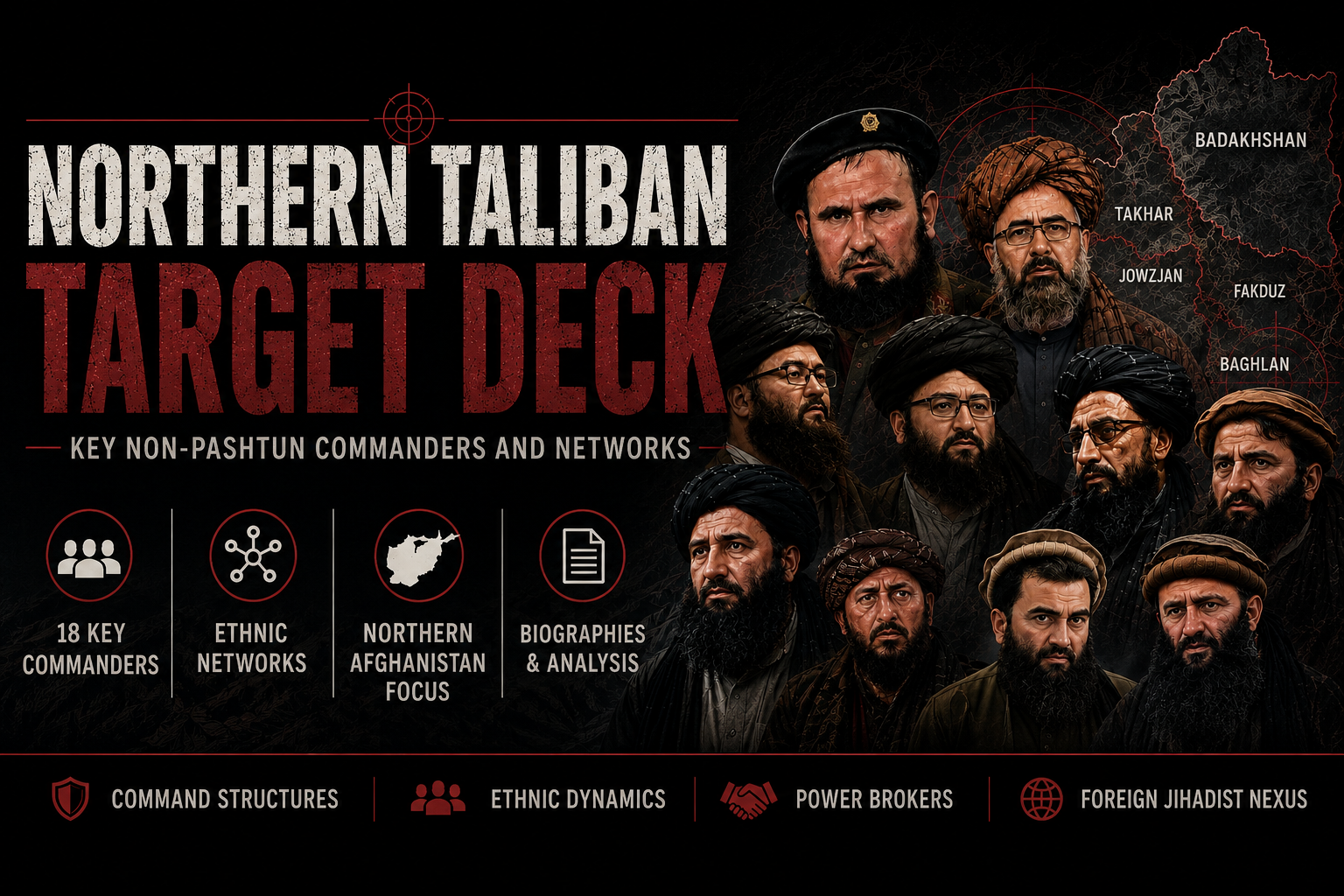
Key Non-Pashtun
Commanders and Network
BLUF: Northern Taliban commanders
remain an important target set because they sit at the intersection of
Taliban battlefield power, ethnic and regional influence, foreign
fighter networks, and a growing internal struggle over trust, authority,
and control.
Targeting Overview
The Taliban’s control of northern Afghanistan did not happen through
Pashtun command networks alone. A group of Tajik, Uzbek, and Turkmen
Taliban commanders played a decisive role in the collapse of the north
before August 15, 2021. These commanders provided local access, ethnic
reach, battlefield legitimacy, and foreign fighter relationships that
helped the Taliban expand into areas where southern Taliban networks had
less natural influence.
Their trajectories since the Taliban returned to power tell a second
story. Some were rewarded with senior military, intelligence,
provincial, and government positions. Others were transferred,
marginalized, arrested, or moved away from the networks and geographic
power bases they spent years building. Those decisions provide insight
not only into how the Taliban redistributed power after victory, but
also into how its senior leadership appears to view the commanders who
helped deliver the north.
The emerging pattern suggests a distinction between wartime value and
postwar trust. Northern commanders were essential when the Taliban
needed local relationships, fighters, and battlefield access. Once the
movement controlled the state, however, some of those same independent
networks and regional power bases became more complicated. Recent
decisions to place senior southern commanders over security operations
in the north further suggest that battlefield credibility does not
necessarily equal enduring confidence from the Taliban’s leadership.
Several of these figures also maintain reported ties to foreign
fighter networks, including the Turkistan Islamic Party, the Islamic
Movement of Uzbekistan, and Jamaat Ansarullah Tajikistan. That makes
this network more than an internal Taliban issue. Changes in who the
Taliban trusts, promotes, sidelines, or removes can also affect the
foreign fighter networks, training infrastructure, and terrorist
relationships operating across northern Afghanistan.
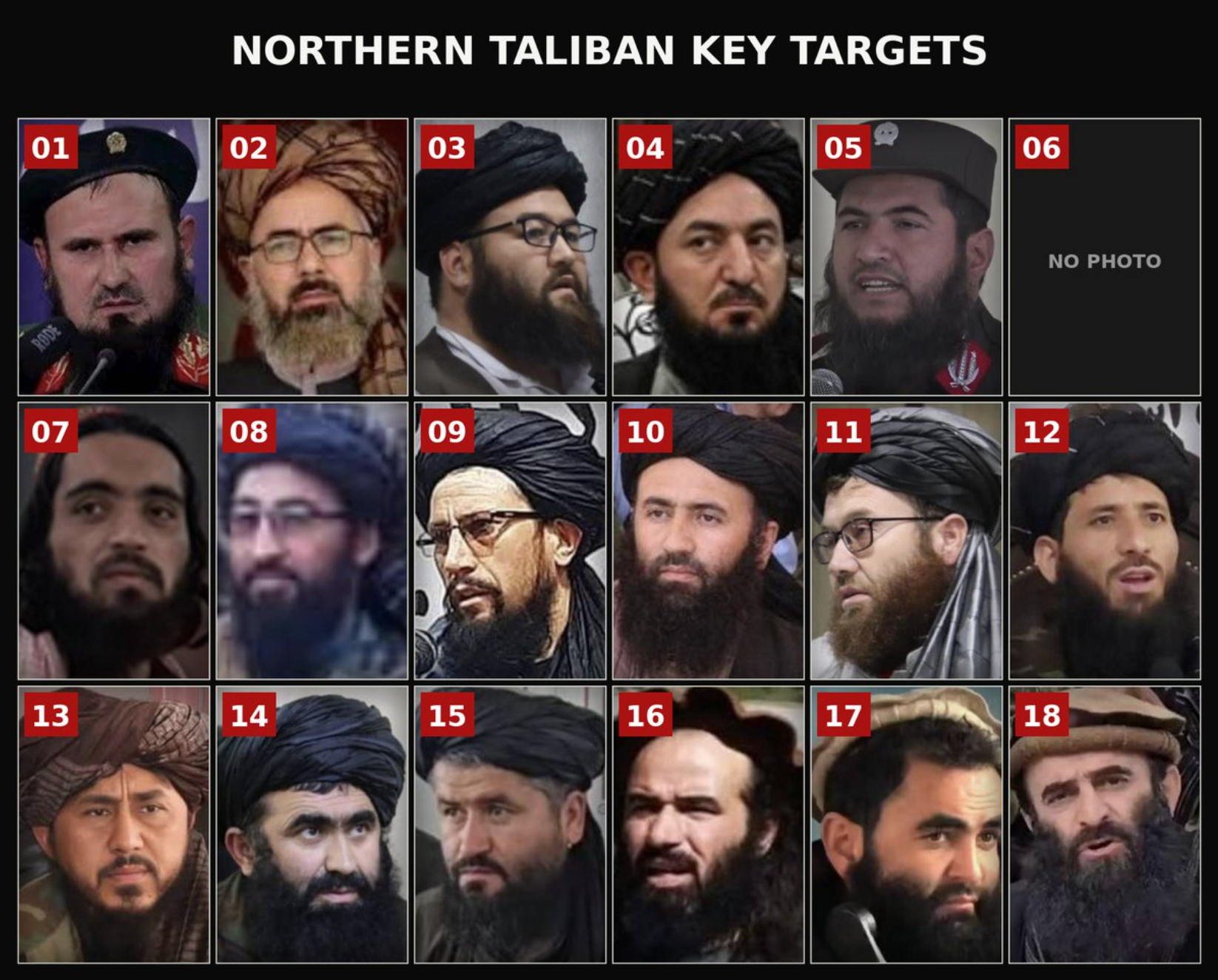
TARGET DECK
TARGET 01 | QARI FASIHUDDIN FITRAT
TARGET 02 | QARI MOHAMMAD ISMAIL RASEKH
TARGET 03 | QARI HAFIZULLAH PAHLAWAN
TARGET 04 | QARI SALAHUDDIN AYUBI
TARGET 05 | MAWLAWI MAKHDOM MOHAMMAD ALAM RABBANI
TARGET 06 | MAWLAWI KHAN MOHAMMAD ARIF
TARGET 07 | MAWLAWI ASADULLAH MURADI
TARGET 08 | MUFTI MOHAMMAD MAQSAD
TARGET 09 | MAWLAWI NEK MOHAMMAD HUDAIFA
TARGET 10 | MAWLAWI MOHAMMAD ZARIF MUZAFFAR
TARGET 11 | MAWLAWI ATAULLAH OMARI
TARGET 12 | MULLAH SHUAIB RESALAT
TARGET 13 | MULLAH MOHAMMAD NADER HAQJO
TARGET 14 | MAWLAWI AMANUDDIN MANSOUR
TARGET 15 | QARI MOHAMMAD AMIN TAYEB
TARGET 16 | MULLAH JUMA KHAN FATEH
TARGET 17 | MULLAH ABDUL JAMIL RAHMANI
TARGET 18 | MAWLAWI ABDUL HAMID KHORASANI
TARGET PROFILES
TARGET 01 | QARI FASIHUDDIN FITRAT
Chief of the General Staff | Taliban Ministry of
Defense
ETHNICITY: Tajik ORIGIN: Warduj
District, Badakhshan Province CURRENT POSITION: Chief
of the General Staff, Taliban Ministry of Defense
AFFILIATION: Taliban | Badakhshan faction AREA
OF INFLUENCE: Northern and Northeastern Afghanistan
Fitrat was the Taliban’s principal commander responsible for military
operations across northern Afghanistan prior to the fall of the former
Afghan government. He served as Taliban Shadow Governor of Badakhshan,
Head of the Military Commission, and one of Mullah Yaqoob’s three
deputies, with responsibility for the northern front. His operational
portfolio reportedly covered approximately nine northern and
northeastern provinces, including Badakhshan, Takhar, Kunduz, and
Baghlan.
Fitrat played a central role in the Taliban’s capture of northern
Afghanistan and later Panjshir, earning him the nickname
“Conqueror of the North” within the Taliban. Unlike
several other Non-Pashtun commanders whose influence declined after the
Taliban takeover, Fitrat was elevated into the national military
leadership. He has served as Chief of the General Staff since September
2021.
TARGET NOTE: Fitrat’s importance comes not only from
his current position, but from the combination of battlefield authority,
relationships with northern commanders, and continued access to the
Taliban’s senior military leadership.
TURKMEN NETWORK
TARGET 02 | QARI MOHAMMAD ISMAIL RASEKH
Governor of Jowzjan Province
ETHNICITY: Turkmen AREA OF
INFLUENCE: Takhar and Jowzjan Provinces CURRENT
POSITION: Governor of Jowzjan Province PRE-2021
ROLE: Taliban Shadow Governor of Takhar Province
Rasekh was one of the Taliban’s most important Turkmen commanders
during the insurgency and played an active role in military operations
across northeastern Afghanistan. After the Taliban takeover, he moved
through a series of senior military, police, and provincial positions,
including Deputy Commander of the 217 Omari Corps, Governor of Takhar,
Commander of the 203 Mansouri Corps, and Police Chief of Jowzjan. In
July 2026, he was promoted to Governor of Jowzjan Province.
TARGET NOTE: Rasekh remains one of the relatively
few senior Turkmen officials to retain significant authority within the
Taliban structure, with much of his influence concentrated in northern
Afghanistan.
TARGET 03 | QARI HAFIZULLAH PAHLAWAN
Turkmen Taliban Commander | TIP Nexus
ETHNICITY: Turkmen AREA OF
INFLUENCE: Faryab and Jowzjan Provinces SELF-DESCRIBED
ROLE: “Emir of the Turkmen Taliban” FOREIGN JIHADIST
NEXUS: Turkistan Islamic Party (TIP)
Pahlawan was another important Turkmen commander in the Taliban’s
2021 northern campaign. He plays an active role in the Turkistan Islamic
Party. Approximately 1,900 Turkistani Uyghur and
Turkmen foreign fighters are reportedly under his leadership in northern
Afghanistan, particularly in Faryab and Jowzjan, where they are
receiving military training.
After the Taliban takeover, Pahlawan served as Governor of Faryab,
Governor of Jowzjan, and Police Chief of Jowzjan. In 2024, he was
removed from the Jowzjan police position and reassigned as Security
Director of the Badghis Provincial Police, a move characterized as part
of the marginalization of Non-Pashtun Taliban commanders.
TARGET NOTE: Pahlawan remains important despite his
reduced official standing because of his reported foreign fighter
relationships and historical influence among the Taliban’s Turkmen
networks.
NETWORK ASSESSMENT: Rasekh and Pahlawan followed two
different post-2021 trajectories. Rasekh retained and recently increased
his formal authority, while Pahlawan was moved away from his traditional
northern power base. Together, they illustrate both the Taliban’s
reliance on Turkmen commanders during the conquest of the north and the
uneven distribution of power that followed.
UZBEK NETWORK
TARGET 04 | QARI SALAHUDDIN AYUBI
Former Faryab Shadow Governor | Reported IMU
Nexus
ETHNICITY: Uzbek ORIGIN: Qaisar
District, Faryab Province AREA OF INFLUENCE: Northern
Afghanistan, particularly Faryab FOREIGN JIHADIST
NEXUS: Islamic Movement of Uzbekistan (IMU)
Ayubi served as the Taliban Shadow Governor of Faryab and Head of the
Military Commission from approximately 2013 to 2015, making him a
principal Taliban commander in the Uzbek-populated areas of northern
Afghanistan. On August 15, 2021, he was among the first Taliban figures
to enter the Presidential Palace in Kabul.
After the takeover, Ayubi held several positions, including Chief of
Staff of the 203 Mansouri Corps, Police Chief of Zabul Province, and
Governor of Logar Province. He has experienced ethnic disagreements with
Taliban leadership and at times reduced his communication with the
center. His longstanding relationships with the IMU reportedly continue
today.
TARGET NOTE: Ayubi represents another important
bridge between the Taliban’s northern Uzbek command structure and the
IMU, while his history of friction with the central Taliban leadership
makes his position within the network particularly noteworthy.
TARGET 05 | MAWLAWI MAKHDOM MOHAMMAD ALAM
RABBANI
Former Faryab Military Commission Chief | IMU
Nexus
ETHNICITY: Uzbek
ORIGIN: Faryab Province AREA OF
INFLUENCE: Faryab, Jowzjan, and Sar-e Pol FOREIGN
JIHADIST NEXUS: Islamic Movement of Uzbekistan (IMU)
Before 2021, Makhdoom Mohammad Alam Rabbani was one of the Taliban’s
most important Uzbek commanders. He headed the Taliban Military
Commission in Faryab and was responsible for military operations across
Faryab, Jowzjan, and Sar-e Pol. He joined the Taliban in 2004 and later
played a significant role in the capture of Faryab Province.
Rabbani maintains key ties with the Islamic Movement of Uzbekistan
(IMU). His daughter is married to Mawlawi Ibrahim Uzbek, IMU’s military
commander. As many as 1,200 Uzbek foreign fighters affiliated with the
IMU are reportedly receiving military training in Faryab and Jowzjan
under Rabbani’s leadership.
After the Taliban takeover, Rabbani served as Deputy Governor of
Faryab. He was arrested in 2022 on kidnapping charges, triggering
significant protests in Faryab, and was later released and appointed
Police Chief of Ghazni Province. He has since remained largely
marginalized.
TARGET NOTE: Rabbani’s importance extends beyond his
current official standing. His longstanding influence in Faryab,
reported IMU relationships, family connection to IMU leadership, and
reported access to a substantial foreign fighter network make him a key
personality within the Northern Taliban target set.
TARGET 06 | MAWLAWI KHAN MOHAMMAD ARIF
Former Faryab Railway Official | Northern Uzbek
Commander
ETHNICITY: Uzbek AREA OF INFLUENCE:
Takhar and Faryab Provinces PRE-2021 ROLE: Taliban
Commander in Northern Afghanistan POST-2021 ROLE:
Official Responsible for the Aqina Railway Line, Faryab Province
Before 2021, Mawlawi Khan Mohammad Arif was a Taliban commander
operating in Takhar and Faryab Provinces, although detailed information
regarding his military responsibilities remains limited. Following the
Taliban takeover, he was appointed as the official responsible for the
Aqina Railway Line in Faryab Province.
In 2022, Arif was arrested in Kabul in connection with ethnic
disputes, placing him among several Northern Uzbek Taliban figures who
experienced friction with the Taliban leadership after the movement
returned to power.
TARGET NOTE: Arif is relevant less because of his
post-2021 position than because his trajectory reflects the broader
treatment of Northern Uzbek commanders after the Taliban victory. His
arrest amid ethnic disputes provides another indicator of tensions
between Non-Pashtun Taliban networks and the movement’s central
leadership.
TARGET 07 | MAWLAWI ASADULLAH MURADI
Faryab Taliban Commander | Former Military Unit
Coordinator
ETHNICITY: Uzbek ORIGIN: Qalbandi
Village, Shirin Tagab District, Faryab Province AREA OF
INFLUENCE: Faryab Province CURRENT POSITION:
No Official Taliban Government Position
Before 2021, Mawlawi Asadullah Muradi was responsible for
coordinating Taliban military units in Faryab Province and emerged as an
important local commander during the campaign to capture northern
Afghanistan. He participated in operations that contributed to the fall
of several districts in Faryab and the provincial capital, Maimana.
Muradi operates alongside approximately 80 well-equipped fighters and
maintained considerable support among both the local population and
Taliban members. Despite his role in the northern campaign, Muradi
currently holds no official position within the Taliban government.
TARGET NOTE: Muradi demonstrates why formal
government positions alone do not capture the Northern Taliban network.
His importance derives from his pre-2021 battlefield role, local
relationships, and participation in the campaign that brought Faryab
under Taliban control.
TARGET 08 | MUFTI MOHAMMAD MAQSAD
Commander, 3rd Infantry Brigade of Sar-e Pol
ETHNICITY: Uzbek CURRENT POSITION:
Commander, 3rd Infantry Brigade of Sar-e Pol AREA OF
INFLUENCE: Sar-e Pol Province STATUS:
Active
Mufti Mohammad Maqsad is an Uzbek Taliban commander who played a key
role in the Taliban’s capture of northern Afghanistan. He currently
commands the 3rd Infantry Brigade of Sar-e Pol and remains active within
the Taliban’s northern military structure.
TARGET NOTE: Although less information is available
regarding Maqsad than several other commanders in this target set, his
continuing brigade command provides an important link between the Uzbek
commanders who participated in the northern campaign and the Taliban’s
current military structure in Sar-e Pol.
TARGET 09 | MAWLAWI NEK MOHAMMAD HUDAIFA
Former Faryab and Ghor Police Chief | Northern Uzbek
Commander
ETHNICITY: Uzbek PREVIOUS
POSITIONS: Police Chief of Faryab Province | Police Chief of
Ghor Province NETWORK: Northern Non-Pashtun Taliban
Mawlawi Nek Mohammad Hudaifa is an Uzbek Taliban commander who has
held senior provincial security positions since the Taliban takeover,
including serving as Police Chief of both Faryab and Ghor Provinces. He
is identified as an influential figure within the Taliban’s Non-Pashtun
northern network.
TARGET NOTE: Hudaifa’s importance lies in his
movement through provincial police leadership and his continuing
identification as an influential Non-Pashtun Taliban figure. His
inclusion helps complete the picture of Uzbek commanders who
transitioned from the insurgency into Taliban security institutions
after 2021.
TARGET 10 | MAWLAWI MOHAMMAD ZARIF MUZAFFAR
Governor of Sar-e Pol | Reported Foreign Fighter
Network
ETHNICITY: Uzbek ORIGIN: Kohistanat
District, Sar-e Pol Province CURRENT POSITION: Governor
of Sar-e Pol Province AREA OF INFLUENCE: Sar-e Pol and
Northern Afghanistan
Before 2021, Muzaffar was one of the Taliban’s principal commanders
in Sar-e Pol Province. He controlled Kohistanat for an extended period
and played an active role in the Taliban’s capture of northern
Afghanistan. He reportedly commands approximately 3,000 fighters, the
majority of whom are foreign jihadists. Following the Taliban takeover,
Muzaffar became the first Taliban Governor of Sar-e Pol and later served
as Commander of the 207 Al-Farooq Corps in Herat and Deputy Minister for
Technical and Logistics Affairs at the Taliban Ministry of Defense. He
returned as Governor of Sar-e Pol in 2024.
TARGET NOTE: Muzaffar combines provincial authority
with a substantial reported armed network. His ability to retain senior
positions despite previous tensions with Taliban leadership makes him an
important Uzbek power broker within the Northern Taliban target set.
TARGET 11 | MAWLAWI ATAULLAH OMARI
Minister of Agriculture | Former 209 Al-Fath Corps
Commander
ETHNICITY: Uzbek CURRENT POSITION:
Taliban Minister of Agriculture PREVIOUS POSITION:
Commander, 209 Al-Fath Corps FOREIGN JIHADIST NEXUS:
Islamic Movement of Uzbekistan (IMU)
Omari is an influential Uzbek Taliban military figure who
transitioned from senior military command into the Taliban government.
Before becoming Minister of Agriculture, he commanded the 209 Al-Fath
Corps, one of the Taliban’s principal military formations in northern
Afghanistan. Omari maintains key ties with the Islamic Movement of
Uzbekistan.
TARGET NOTE: Omari is significant because his
current civilian ministry position can obscure his military background.
His former command of the 209 Al-Fath Corps and reported IMU
relationships place him firmly within the Northern Taliban military
network.
TARGET 12 | MULLAH SHUAIB RESALAT
Governor of Samangan Province
ETHNICITY: Uzbek ORIGIN: Gurzewan
District, Faryab Province CURRENT POSITION: Governor of
Samangan PREVIOUS POSITIONS: Governor of Jowzjan |
Governor of Faryab
Resalat was a local Taliban commander in Gurzewan before 2021. Since
the takeover, he has moved through three northern governorships, serving
in Jowzjan, Faryab, and currently Samangan.
TARGET NOTE: His repeated appointment to northern
governorships makes Resalat relevant to understanding how the Taliban
continues to employ Uzbek commanders in provincial administration.
TARGET 13 | MULLAH MOHAMMAD NADER HAQJO
Northern Uzbek Commander
ETHNICITY: Uzbek PREVIOUS
POSITIONS: Police Chief of Faryab | Commander, 1st Infantry
Brigade in Sar-e Pol | Deputy Governor of Takhar KEY
ASSOCIATION: Mawlawi Abdul Salam Hanafi
Haqjo has held several security and administrative positions across
northern Afghanistan. He is an influential Northern Taliban figure and a
close associate of Taliban Deputy Prime Minister for Administrative
Affairs Mawlawi Abdul Salam Hanafi.
TARGET NOTE: Haqjo provides an important link
between the northern Uzbek military network and senior Taliban political
leadership.
NETWORK ASSESSMENT: The Uzbek network represents the
largest component of this Northern Taliban target set. These commanders
were instrumental in extending Taliban military power into
Uzbek-populated areas of northern Afghanistan before August 2021,
particularly across Faryab, Jowzjan, Sar-e Pol, and Takhar. Their
trajectories after the takeover have varied considerably. Some moved
into senior government, military, or provincial positions, while others
were arrested, marginalized, transferred away from their traditional
power bases, or left without formal positions. Several also maintain
reported relationships with the Islamic Movement of Uzbekistan or other
foreign fighter networks. Taken together, the pattern shows both how
heavily the Taliban relied on Uzbek commanders during the conquest of
the north and how unevenly authority was redistributed after
victory.
BADAKHSHAN / TAJIK NETWORK
TARGET 14 | MAWLAWI AMANUDDIN MANSOUR
Governor of Helmand | Former 217 Omari Corps
Commander
ETHNICITY: Tajik ORIGIN: Badakhshan
Province CURRENT POSITION: Governor of Helmand Province
NETWORK: Badakhshan faction associated with Qari
Fasihuddin Fitrat FOREIGN JIHADIST NEXUS: Jamaat
Ansarullah Tajikistan
Mansour is a prominent member of the Taliban’s Badakhshan faction and
is associated with Target 01, Qari Fasihuddin Fitrat. Since the Taliban
takeover, he has moved through a series of important military and
provincial positions, including Governor of Badakhshan, Deputy Commander
of the 209 Al-Fath Corps, Commander of the Taliban Air Force, and
Commander of the 217 Omari Corps. Since October 2025, he has served as
Governor of Helmand Province.
Mansour is the Deputy for Military Operations of Jamaat Ansarullah
Tajikistan. Approximately 900 Jamaat Ansarullah fighters are reportedly
under his leadership and are being trained in Badakhshan and at the
former Camp Dwyer in Helmand Province.
TARGET NOTE: Mansour is particularly important
because his network appears to extend beyond Badakhshan. His movement
into Helmand, combined with the reported relocation of Jamaat Ansarullah
fighters there, suggests that his influence and foreign fighter
relationships should not be viewed solely through a northern Afghanistan
lens.
TARGET 15 | QARI MOHAMMAD AMIN TAYEB
Deputy Governor of Badakhshan | Former 313 Central Corps
Deputy Commander
ETHNICITY: Tajik ORIGIN: Badakhshan
Province CURRENT POSITION: Deputy Governor of
Badakhshan Province PREVIOUS POSITION: Deputy
Commander, 313 Central Corps AREA OF INFLUENCE:
Badakhshan and Northern Afghanistan
Tayeb is another senior Tajik commander from Badakhshan. Before 2021,
approximately 1,200 Tajik, Uzbek, and Turkmen fighters operated under
his leadership in military units across northern Afghanistan. He later
served as Deputy Commander of the 313 Central Corps and currently serves
as Deputy Governor of Badakhshan.
TARGET NOTE: Tayeb represents another important node
in the Badakhshan network. His reported pre-2021 command over a sizable
multiethnic militant force and continued provincial authority make him
relevant to understanding the enduring northern command structure.
TARGET 16 | MULLAH JUMA KHAN FATEH
Former Deputy Governor of Zabul | Badakhshan Taliban
Commander
ETHNICITY: Tajik ORIGIN: Badakhshan
Province PREVIOUS POSITION: Deputy Governor of Zabul
Province NETWORK: Northern / Badakhshan Taliban
Mullah Juma Khan Fateh is a Tajik Taliban commander from Badakhshan
Province who previously served as Deputy Governor of Zabul Province. He
was subsequently removed from that position following reported
disagreements with Taliban Supreme Leader Mullah Hibatullah
Akhundzada.
TARGET NOTE: Fateh adds another example of a
Badakhshan commander whose post-2021 trajectory included movement
outside his traditional northern power base followed by friction with
the Taliban’s central leadership. His removal following reported
disagreements with Hibatullah makes his relationship with the Taliban
leadership particularly relevant when assessing the status of the
broader Badakhshan network.
TARGET 17 | MULLAH ABDUL JAMIL RAHMANI
Commander, 15th Border Brigade
ETHNICITY: Tajik ORIGIN: Badakhshan
Province CURRENT POSITION: Commander, 15th Border
Brigade AREA OF INFLUENCE: Badakhshan
Rahmani is a Tajik Taliban commander from Badakhshan who currently
commands the Taliban’s 15th Border Brigade in the
province.
TARGET NOTE: Rahmani’s command position makes him a
strategic operational node in the Badakhshan target network.
NETWORK ASSESSMENT: The Badakhshan network stands
apart because it connects Target 01 Qari Fasihuddin Fitrat’s position at
the highest levels of the Taliban military with a broader group of Tajik
commanders who emerged from the same northern power base. Mansour
extends that network beyond Badakhshan through senior military and
provincial appointments and his reported relationship with Jamaat
Ansarullah Tajikistan, while Tayeb and Rahmani retain positions inside
Badakhshan’s provincial and military structure. Fateh’s removal
following reported disagreements with Mullah Hibatullah Akhundzada adds
another example of the uneven relationship between Northern Tajik
commanders and the Taliban’s central leadership. Together, these figures
show that the Badakhshan network remains influential, but its members
have experienced markedly different trajectories since the Taliban
takeover.
ADDITIONAL TAJIK TARGET OF
INTEREST
TARGET 18 | MAWLAWI ABDUL HAMID KHORASANI
Former Panjshir Security Director | Badri 313 / Intelligence
Links
ETHNICITY: Tajik ALIAS: Nasser
Badri ORIGIN: Anaba District, Panjshir Province
PREVIOUS ROLES: Security Director of Panjshir |
District Governor in Paktia | Badri 313-affiliated commander
OTHER NEXUS: Taliban intelligence structure
Khorasani joined the Taliban shortly before the collapse of the
former government and subsequently participated in the capture of
Panjshir and operations against the National Resistance Front. He later
held security and military positions and worked within the Taliban
intelligence structure. He has also experienced repeated periods of
friction with Taliban leadership, including being disarmed and arrested
before later being released.
TARGET NOTE: Khorasani remains a target of interest
because of his Panjshir background, involvement in operations against
the resistance, and reported connections to both Badri 313 and Taliban
intelligence. He is a highly controversial figure who has frequently
made statements involving ethnic bias, the marginalization of
non-Pashtun commanders, and strong rhetoric against Iran and
Pakistan.
KEY JUDGMENTS
The Taliban’s northern campaign depended heavily on Tajik, Uzbek, and
Turkmen commanders who possessed the local access, fighters,
relationships, and battlefield credibility necessary to expand the
movement beyond its traditional southern power base. Their contribution
to the Taliban’s 2021 victory was operationally significant and, in
several cases, resulted in senior positions after the collapse of the
former Afghan government.
The Taliban appears to distinguish between battlefield
usefulness and political trust. The post-2021 treatment of
northern commanders has been uneven. Some remain influential, while
others have been transferred, marginalized, arrested, or separated from
their traditional areas of influence. Viewed collectively, these
decisions suggest an effort by the Taliban’s senior leadership to retain
capable northern figures while limiting the development of autonomous
regional power centers.
Recent developments suggest that confidence in some northern
commanders may be declining further. The decision to place
senior southern Pashtun commanders over operations against the expanding
anti-Taliban resistance was reportedly viewed by northern Taliban
commanders as a signal that the leadership no longer trusted them to
contain the threat in areas they once helped conquer. The significance
is not simply the change in command. It is what the change reveals about
internal assessments of loyalty, capability, and control.
The northern commanders remain difficult for the Taliban to
replace completely. Their influence was built through years of
fighting, recruitment, local relationships, and command networks rather
than government appointments alone. Removing or marginalizing them may
reduce their formal authority without eliminating the networks that gave
them influence in the first place.
Foreign jihadist relationships increase the importance of
tracking these personnel changes. Several northern Taliban
commanders maintain reported relationships with the Turkistan Islamic
Party, the Islamic Movement of Uzbekistan, Jamaat Ansarullah Tajikistan,
and associated foreign fighter networks. Changes in command authority
therefore have potential consequences beyond Taliban internal politics,
including for terrorist facilitation, sanctuary, training
infrastructure, and relationships extending into Central Asia.
The most important indicator going forward may be who the
Taliban trusts when pressure increases. Promotions matter, but
so do transfers, arrests, geographic reassignments, parallel command
structures, and the deployment of southern commanders into northern
areas. Taken together, these indicators can reveal which northern
commanders the Taliban continues to regard as trusted partners, which it
views primarily as useful operators, and which it increasingly sees as
potential liabilities.
Originally published by Sarah Adams. View the original post →