The Wrong Question
The heartbreaking flooding in Texas has left many Americans asking
the same question.
How could this happen?
It’s an understandable question. When homes are swept away, children
lose their lives, and entire communities are devastated in a matter of
hours, we naturally search for an explanation. We want to believe there
was a warning that was missed or a single decision that could have
prevented the tragedy. Sometimes there is. More often, disasters are the
result of a series of ordinary decisions colliding with extraordinary
circumstances.
After spending much of my career responding to crises, I’ve come to
believe we’re asking the wrong question.
The better question is, what can we learn before it happens
again?
The recent flooding in Texas is another reminder that flooding
remains one of the fastest moving and least forgiving disasters we face.
Communities that were still recovering from earlier flooding suddenly
found themselves facing another historic event. Nearly one trillion
gallons of rain fell across some of the hardest hit counties over just a
few days, overwhelming rivers, washing away roads and bridges,
destroying homes, and forcing hundreds of water rescues. Families who
had just begun rebuilding found themselves starting over once again
while first responders continued rescue operations under the threat of
additional rainfall. Behind every statistic is a family whose life
changed in a matter of minutes.
Over the past two years alone, catastrophic flooding has devastated
western North Carolina after Hurricane Helene, communities across
Kentucky and Vermont, New Mexico, and now Texas once again. While each
disaster has its own unique circumstances, they all point to the same
reality. Flooding is no longer something Americans should associate only
with hurricanes or coastal communities. It is a preparedness issue for
every community, regardless of geography.
One of the greatest mistakes we make is treating every flood as an
isolated tragedy instead of another chapter in the same lesson. We mourn
the victims, study the damage, and then move on until the next community
finds itself underwater. Preparedness doesn’t work that way. Every
disaster leaves behind lessons, but only if we’re willing to study them
before the next warning arrives.
That’s why I believe we should spend less time asking how this
happened and more time asking what it should teach us.
We Keep Thinking It Won’t
Happen Here
Flooding remains the most common natural disaster in the United
States and one of the deadliest. According to NOAA and the National
Weather Service, floods kill more than one hundred Americans in an
average year while causing billions of dollars in damage. Nearly half of
all flood-related fatalities occur inside vehicles because people
underestimate moving water and overestimate their ability to drive
through it.
Despite those numbers, many Americans still believe flooding is
something that happens somewhere else. If they don’t live along the
coast, next to a major river, or in a neighborhood that has flooded
before, they assume they’re safe.
History tells us otherwise. I learned that lesson firsthand in 2010
while serving in Peshawar, Pakistan, during one of the worst floods in
the country’s history. More than twenty million people were affected as
floodwaters spread across nearly one-fifth of the country. Entire
villages disappeared beneath the water, roads and bridges collapsed, and
what began as a flooding emergency quickly evolved into one of the
largest humanitarian crises in modern history.
What struck me wasn’t simply the scale of the destruction. It was how
quickly the mission changed. Within days, the priority was no longer
just rescuing people. It became sustaining them. Medical care, clean
drinking water, sanitation, fuel, transportation, and logistics suddenly
became just as important as the flood itself. That experience taught me
something I’ve carried throughout my career: disasters evolve, and our
thinking has to evolve with them.
Living in Florida reinforced those lessons in a different way. When
Hurricane Ian struck in 2022, the images of storm surge and destruction
dominated the headlines. What received far less attention was everything
that followed. Communities spent months rebuilding homes, navigating
insurance claims, restoring utilities, reopening businesses, and simply
trying to return to normal. The storm lasted hours. Recovery lasted
months.
Then Hurricane Helene challenged another dangerous assumption. Many
Americans still think flooding is primarily a coastal problem, yet
communities across western North Carolina, hundreds of miles from the
Atlantic Ocean, experienced catastrophic flooding as rivers surged
through mountain valleys, roads disappeared, and entire towns became
isolated. The storm demonstrated that rainfall, terrain, saturated
ground, and drainage systems often matter far more than proximity to the
coastline.
Looking across Pakistan, Hurricane Ian, Hurricane Helene, and now
Texas, it’s remarkable how different these disasters appear on the
surface. Different weather systems. Different terrain. Different
communities.
Yet they all expose the same assumption.
We believe tomorrow will look like yesterday.
Nature has no obligation to honor that assumption.
Water Doesn’t Give You Time
One of the biggest misconceptions about flooding is that people
imagine water rising slowly. Sometimes it does. Flash flooding is
different. Small creeks become raging rivers in minutes, roads that
looked perfectly safe during breakfast can disappear before lunch, and
neighborhoods that have never flooded suddenly become inaccessible
before emergency responders can even arrive. By the time many people
recognize how dangerous the situation has become, they’ve already lost
the one thing they needed most: time.
The recent flooding in Texas demonstrated exactly how quickly
conditions can change. Communities were still recovering from the deadly
July Fourth flooding that claimed more than 130 lives when another round
of historic rainfall overwhelmed rivers once again. Emergency
declarations expanded across multiple counties as first responders
conducted hundreds of water rescues while meteorologists warned that
additional rainfall could further worsen already dangerous
conditions.
In nearly every flood, the most important decisions are made before
anyone realizes they’re making them. A family decides to wait another
hour before leaving. A driver believes they can make it through one more
intersection. Someone assumes the water won’t reach their neighborhood
because it never has before.
Those decisions often feel perfectly reasonable at the time.
Until they aren’t.
Most people also don’t realize how little water it takes to become
deadly. Just six inches of moving water can knock an adult off their
feet, and roughly twelve inches can carry away many passenger vehicles.
The pavement beneath the water may already be gone. The current may be
far stronger than it appears from inside a vehicle. What looks like a
shallow puddle may actually be a washed out roadway with several feet of
fast-moving water beneath the surface.
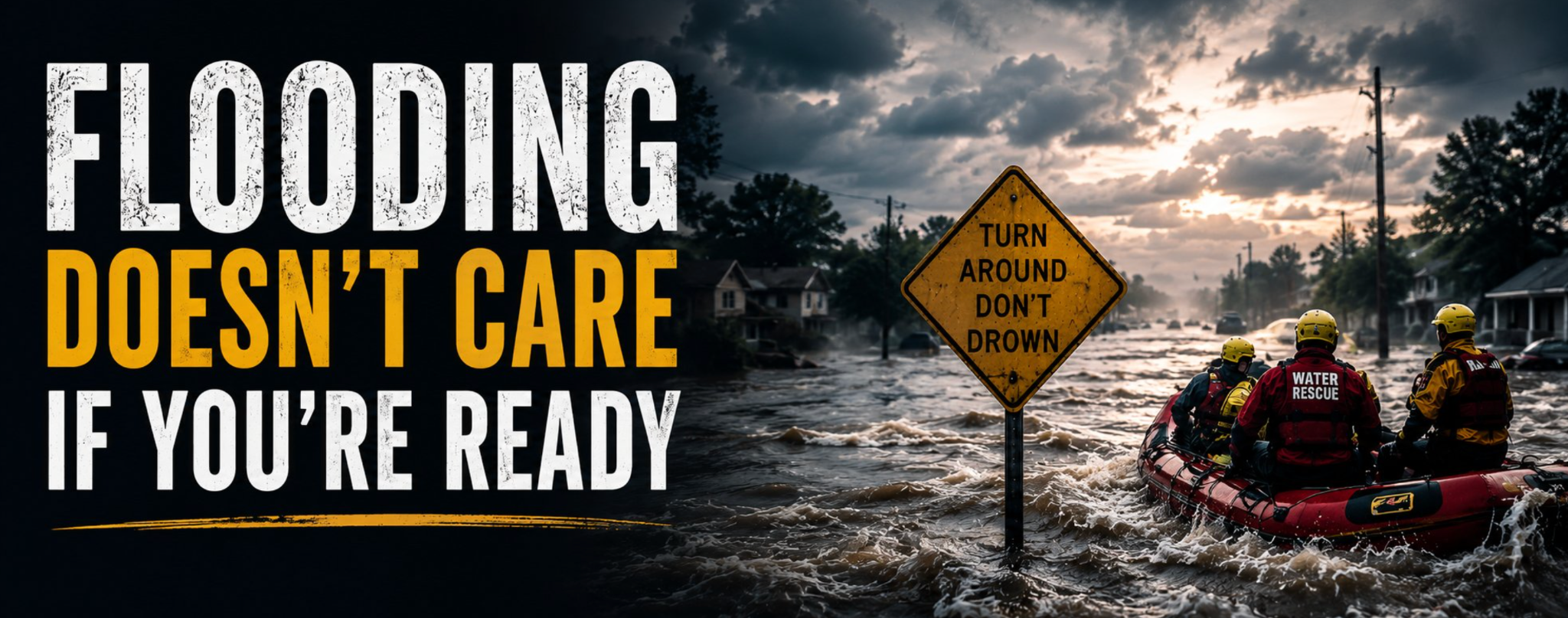
There is a reason emergency managers have repeated the same message
for decades: Turn Around. Don’t Drown. It isn’t simply
a slogan. It is a recognition that floodwaters rarely give people a
second chance to correct a bad decision.
Perhaps that’s the most important lesson flooding teaches us.
Emergencies rarely announce the exact moment when caution should become
action. The challenge is that uncertainty makes people want one more
piece of information before they act. Unfortunately, floods rarely
reward hesitation. They reward people who made the difficult decisions
while they still had the luxury of time.
Disasters Are Really About
Decisions
One of the biggest misconceptions about preparedness is that people
think it’s primarily about equipment. They picture generators, emergency
food, flashlights, batteries, and first aid kits. Those things
absolutely matter, and every household should have them. But after
responding to crises in different parts of the world, I’ve become
convinced that the most important part of preparedness isn’t what you
own. It’s how you think before an emergency ever begins.
Every disaster eventually becomes a series of decisions. Do you leave
now or wait another hour? Do you have another evacuation route if the
main road is underwater? Who is responsible for picking up the children
if schools close unexpectedly? How will you communicate if cell service
is unavailable? Where will family members meet if they become separated?
None of those questions are particularly difficult around the dinner
table on an ordinary Tuesday evening. They become far more difficult
when floodwaters are rising, power is out, and everyone is working with
incomplete information.
That’s really what preparedness is about. It isn’t eliminating
uncertainty because no emergency plan can do that. It’s reducing
uncertainty enough that when conditions begin changing quickly, you
already know what matters most. Instead of spending precious minutes
deciding what to do, you can spend those minutes acting.
One lesson I learned early in my career is that uncertainty has a way
of slowing people down. Faced with incomplete information, people
naturally look for one more update, one more weather forecast, or one
more indication that their concern is justified. Sometimes that’s
appropriate. During fast-moving emergencies, however, waiting for
perfect information often means waiting until your options have already
narrowed.
Flooding illustrates that better than almost any other hazard because
conditions can change dramatically in a very short period of time. A
road that was open fifteen minutes ago may now be underwater. A creek
that looked manageable can become a torrent before emergency responders
have time to close nearby intersections. By the time certainty arrives,
the easiest decision has usually disappeared, leaving only more
difficult choices.
Although flooding provides the example, the lesson extends well
beyond rising water. Wildfires, hurricanes, tornadoes, cyberattacks,
prolonged power outages, and even public safety emergencies all reward
people who have thought through their options before they’re forced to
make them. The hazard changes. Human decision-making doesn’t.
Preparedness, then, isn’t simply about expecting the unexpected. It’s
about reducing the number of important decisions you have to make when
stress, uncertainty, and time are all working against you. The more
decisions you’ve already made before the emergency begins, the more
attention you can devote to the ones that truly require your judgment in
the moment.
Recovery Is Part of
Preparedness
One of the lessons that rarely receives enough attention is that
disasters don’t end when the immediate danger passes. In many ways,
that’s when a different phase of the emergency begins. The television
cameras leave, national attention shifts elsewhere, and recovery quietly
becomes the longest and most demanding part of the crisis.
I saw that firsthand during the Pakistan floods. Once the floodwaters
began to recede, the challenge was no longer simply rescuing people.
Communities faced months of damaged infrastructure, disrupted
transportation, limited access to clean drinking water, sanitation
concerns, and the difficult process of restoring basic services. The
emergency evolved because people’s needs evolved, requiring responders
to think beyond the immediate crisis.
The same pattern repeated itself much closer to home after Hurricane
Ian. While the storm itself dominated the news cycle, the real work
continued long after the winds subsided. Families spent months
rebuilding homes, navigating insurance claims, restoring utilities,
reopening businesses, and trying to regain some sense of normalcy. The
storm lasted hours. Recovery lasted months.
That’s why preparedness shouldn’t stop with evacuation routes and
emergency kits. Families should also consider how they would manage if
they couldn’t return home for several weeks, if schools remained closed,
if paychecks were interrupted, or if basic services took longer than
expected to recover. Those aren’t extreme scenarios. They are common
realities after major disasters.
Recovery also exposes vulnerabilities that often have little to do
with the disaster itself. A family may have enough food and water for
several days but no financial cushion if work is interrupted. A
neighborhood may avoid catastrophic flooding yet remain isolated because
a bridge was washed away. A hospital may survive the storm structurally
but struggle because medical supplies can no longer reach it. Those
secondary effects often shape recovery just as much as the disaster that
caused them.
Looking back, one of the most valuable lessons I’ve taken from
responding to crises is that resilience isn’t measured by whether
hardship occurs. Every community will eventually face disruption of some
kind. What separates those that recover more quickly is their ability to
adapt as conditions change rather than continuing to plan for the
emergency they wish they had instead of the one they’re actually facing.
Preparedness doesn’t end when you’re safe. It continues until life
begins to resemble normal again.
Technology Can Help.
It Can’t Decide For You.
There has never been a better time to prepare for disasters than
today.
Weather forecasting has become dramatically more accurate over the
past several decades. Emergency managers now have access to satellite
imagery, flood modeling, drones, artificial intelligence, and predictive
analytics that would have been unimaginable only a generation ago.
Wireless emergency alerts can reach millions of people in seconds, while
advances in remote sensing and forecasting continue to improve our
ability to anticipate dangerous conditions before they unfold.
Those are remarkable achievements, and they save lives every year.
But technology has an important limitation. It can provide information.
It cannot make decisions.
A forecast can tell you heavy rain is coming. It cannot decide when
your family should leave. A flood map can identify areas at risk. It
cannot choose your evacuation route or determine where your family will
reunite if you become separated. Artificial intelligence may eventually
help emergency managers allocate resources more efficiently, but it
cannot replace human judgment, responsibility, or leadership.
In many ways, technology has made one part of preparedness easier
while making another more challenging. We have access to more
information than ever before, yet that same information can create a
false sense that we have more time than we actually do. People often
wait for one more update, one more forecast, or one more confirmation
before acting. Unfortunately, emergencies rarely reward perfect timing.
They reward good decisions made early enough to preserve options.
Technology should inform our decisions, not replace them. The
responsibility to act will always belong to us. Preparedness doesn’t
require expensive equipment or months of planning. More often than not,
it begins with a handful of simple conversations and small decisions
that most of us postpone because life gets busy.
Take a few minutes to understand your risk. Whether you live near the
coast, beside a creek, or in what has always seemed like a safe
neighborhood, learn how water moves through your community and where it
has flooded before. Yesterday’s assumptions are not a reliable predictor
of tomorrow’s emergency.
Talk with your family before a disaster forces the conversation.
Decide where you’ll meet if you’re separated, who will pick up children
if schools close unexpectedly, and how you’ll communicate if cell
service is unavailable. Those discussions are easy on an ordinary day
and much harder during a crisis.
Practice paying attention to your surroundings. Whether you’re
traveling, commuting, or simply running errands, make a habit of
noticing alternate routes, nearby shelters, or higher ground.
Situational awareness isn’t reserved for first responders. It’s a skill
anyone can develop.
Think beyond the first twenty-four hours. Ask yourself how you would
manage if power remained out for several days, if roads were closed, or
if you couldn’t return home for a week. Recovery often presents
challenges that receive far less attention than the disaster itself.
Finally, resist the temptation to believe that preparedness is
something you’ll get around to later. Every emergency eventually reaches
the point where preparation is no longer possible and only decisions
remain. The best time to prepare is while you still have the luxury of
choosing when and how to do it.
What Every Flood Has Taught
Me
Looking back over the floods I’ve experienced or watched unfold, from
Pakistan in 2010 to Hurricanes Ian and Helene, and now the heartbreaking
losses in Texas, the geography is always different. The weather is
different. The communities are different. The lessons rarely are.
Every flood has reinforced that water almost always moves faster than
people expect. During the Pakistan floods, I watched roads disappear,
bridges collapse, and communities become isolated almost overnight. Like
many others, I found myself stranded for about a week as transportation
routes became impassable. What began as a rescue operation quickly
became a humanitarian crisis as access to clean water, medical care,
sanitation, and basic supplies became just as important as getting
people out of the floodwaters. It was a reminder that disasters don’t
end when the rain stops. They evolve.
Hurricane Ian taught me something different. Living in Florida, I
watched entire communities spend months recovering after the storm had
passed. Long after the headlines disappeared, families were still
rebuilding homes, navigating insurance claims, restoring businesses, and
trying to regain a sense of normalcy. Recovery isn’t separate from
preparedness. It’s part of it.
Then Hurricane Helene challenged another dangerous assumption. Many
Americans still think flooding is primarily a coastal problem, yet
communities across western North Carolina, hundreds of miles from the
Atlantic Ocean, experienced catastrophic flooding as rivers surged
through mountain valleys and roads simply vanished. The storm
demonstrated that rainfall, terrain, and drainage patterns often matter
far more than proximity to the ocean.
Now, Texas has reminded us once again how little time flash floods
leave for hesitation. The tragic losses across communities and at the
summer camps illustrate how quickly conditions can change and how
decisions made minutes earlier can lead to entirely different
outcomes.
Across every one of these disasters, I’ve come back to the same
conclusion.
Emergencies expose assumptions.
They reveal the plans we never made, the conversations we never had,
and the risks we convinced ourselves would never become reality.
Preparation doesn’t guarantee everything will go right, but it gives you
more options when everyone else is running out of them.
Perhaps the biggest lesson of all is this: preparedness isn’t about
living in fear. It’s about reducing uncertainty before uncertainty is
forced upon you. The people who consistently fare best during disasters
aren’t necessarily the ones with the biggest emergency kits. They’re the
ones who have already thought through the difficult decisions while they
still had the luxury of time.
What Comes Next
Every disaster leaves us asking the same question.
How could this happen?
It’s a natural question, but it isn’t the one that makes us better
prepared.
Floods will continue to occur. Some will happen along the coast.
Others will strike mountain communities, rural towns, or neighborhoods
that have never experienced serious flooding before. We can’t prevent
every disaster, but we can decide how we prepare for them.
Every flood leaves behind more than damaged homes and washed out
roads. It leaves behind lessons. Those lessons are often written in
painful ways, but they become invaluable if we’re willing to learn from
them before the next emergency arrives.
Preparedness has never been about expecting the worst. It’s about
recognizing that disruptions are a normal part of life and deciding not
to let one bad day become the defining day of your life or your family’s
future.
That’s what comes next.
Not simply rebuilding homes, repairing roads, or restoring power,
although all of those things matter. What comes next is deciding whether
we’re willing to learn from what happened and make better decisions
before the next emergency arrives.
So perhaps the question we should ask after Texas isn’t simply,
“How could this happen?”
It’s a better question.
What can we learn before it happens again?
Originally published by Sarah Adams. View the original post →