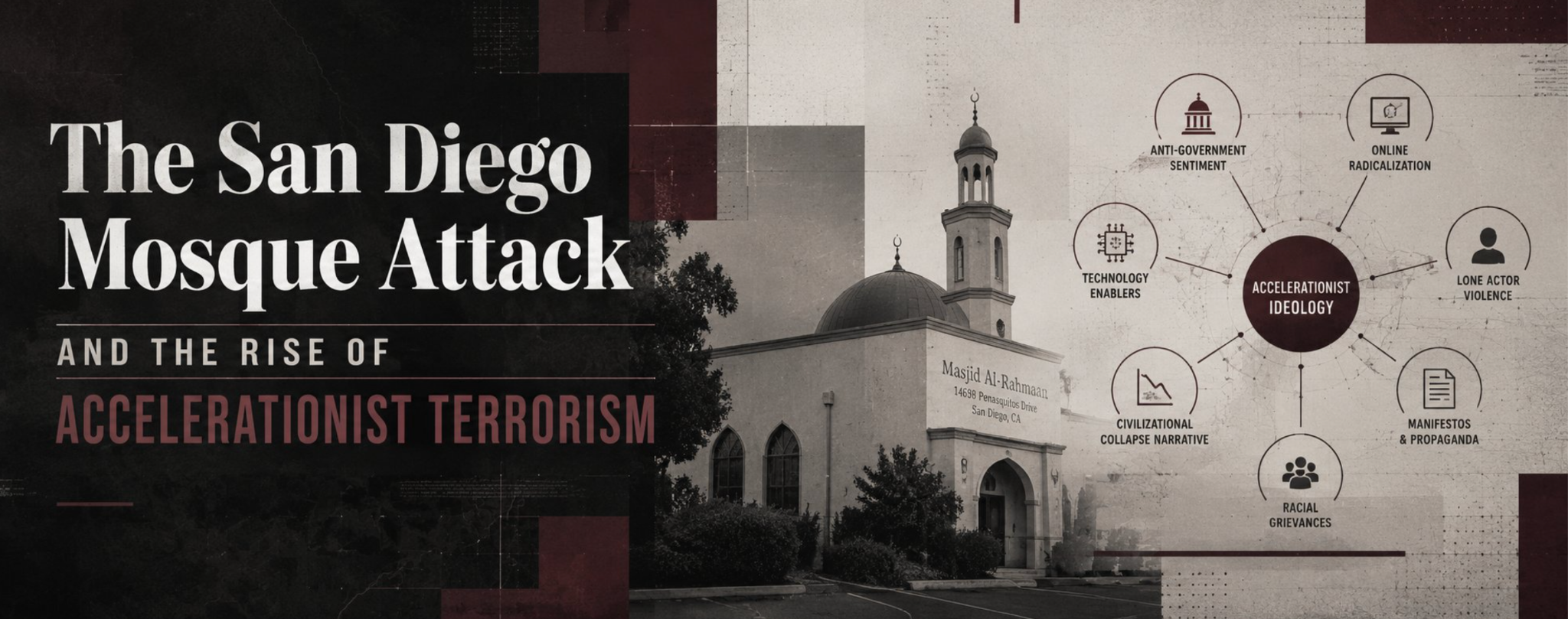
On May 18, 2026, two teenagers armed with rifles, body armor, neo
Nazi insignia, and livestreaming equipment opened fire at the Islamic
Center of San Diego, the largest mosque in the city. Three people were
killed in the attack.
- Security guard Amin Abdullah reportedly engaged the attackers with
his own firearm, helped lock down the attached Islamic school protecting
roughly 140 children, and drew fire away from worshippers inside. - Mansour “Abdul” Kaziha, a longtime caretaker, handyman, cook, and
storekeeper who had served the mosque community for decades, was also
killed after helping divert the attackers away from the school
building. - Nadir Awad, who lived across the street from the mosque and whose
wife taught at the Islamic school, reportedly rushed toward the gunfire
after hearing the attack begin and also helped pull attention away from
the classrooms before he was killed
Authorities say the shooters, Cain Lee Clark, 17, and Caleb Liam
Vazquez, 18, later died from self-inflicted gunshot wounds after fleeing
the scene.
At first glance, the attack resembles the growing list of
ideologically motivated mass casualty incidents that have defined the
past decade. Yet investigators increasingly believe this case represents
something more specific and more concerning: a textbook example of
modern accelerationist extremism. While many Americans are familiar with
terms such as white supremacy, neo Nazi extremism, or domestic
terrorism, far fewer understand accelerationism, an increasingly
influential ideology within violent extremist ecosystems online. That
gap matters because accelerationism may now represent one of the most
dangerous ideological currents shaping the future domestic terrorism
landscape.
The Attack Was Not Random
According to investigators, the attackers arrived heavily armed with
multiple firearms, tactical gear, and symbols associated with neo Nazi
and militant accelerationist movements. Weapons reportedly carried SS
symbols and phrases such as “Race War,” while their equipment included
Sonnenrad imagery, often referred to as the “Black Sun,” a symbol that
has become deeply embedded in modern white supremacist extremist culture
online.
For many readers, these symbols may appear obscure or disconnected
from modern violence, but within extremist ecosystems they carry highly
specific meaning. The SS bolts originate from the Schutzstaffel, the
paramilitary organization that helped enforce Adolf Hitler’s Nazi regime
and oversaw some of the worst atrocities of the Holocaust. The
Sonnenrad, meanwhile, has evolved into one of the most recognizable
symbols used within contemporary neo Nazi and accelerationist circles.
It frequently appears in propaganda connected to groups such as
Atomwaffen Division and online extremist networks linked to “Siege
Culture.”
Investigators also reportedly found references to groups and
ecosystems such as “Terrorgram,” a decentralized network of extremist
Telegram channels known for distributing propaganda, attack manifestos,
bomb making guides, and violent accelerationist material. Terrorgram
channels have repeatedly celebrated mass casualty attacks and encouraged
followers to conduct decentralized acts of violence in order to
destabilize society. Unlike traditional terrorist organizations with
formal leadership structures, these ecosystems often function through
loose digital communities built around propaganda, aesthetics, and
ideological reinforcement.
Authorities also say portions of the attack were livestreamed,
reflecting an increasingly common pattern among modern extremist
attackers seeking not only to kill, but to amplify fear and inspire
future violence through digital propaganda. Following the attack,
investigators reportedly recovered dozens of firearms and weapons from
residences connected to the suspects. Yet it is the manifesto recovered
after the shooting that provides the clearest insight into the ideology
driving the attack.
The New Crusade: Sons of
Tarrant
Authorities are currently reviewing the roughly 75-page manifesto
reportedly authored jointly by the attackers. The title alone, “The New
Crusade: Sons of Tarrant,” reveals the ideological lineage behind the
attack. It directly references the Christchurch mosque shootings carried
out by Brenton Tarrant, whose massacre of 51 Muslim worshippers in 2019
fundamentally reshaped the trajectory of modern extremist violence.
Christchurch was not simply a terrorist attack. It became a
blueprint. Tarrant merged manifesto culture, livestreamed violence,
meme-driven propaganda, irony, symbolism, and internet virality into a
model designed not only to terrorize victims but to radicalize and
inspire copycats globally. Investigators believe the San Diego attackers
intentionally modeled themselves after that framework.
The manifesto itself reportedly blended neo Nazi ideology,
accelerationist rhetoric, ecofascism, incel-style grievances, nihilism,
and internet meme culture into a sprawling call for violence and
societal collapse. Investigators say the shooters openly praised prior
attackers, referenced extremist literature almost “biblically,” and
framed the attack as part of a broader effort to accelerate instability
and racial conflict.
Understanding
Accelerationism
At its core, accelerationism is the belief that modern society is
irreparably corrupt and must be pushed toward collapse through violence,
polarization, fear, and chaos. The objective is not reform. The
objective is destruction.
Accelerationists believe acts of terrorism can accelerate societal
breakdown by provoking racial conflict, civil unrest, political
instability, government crackdowns, and broader social fragmentation.
From their perspective, collapse creates the opportunity for a new
ideological order to emerge from the ruins.
The ideology draws heavily from the writings of James Mason and his
anthology Siege, which advocated decentralized violence, terrorism, and
“leaderless resistance” over traditional political organizing. Other
foundational texts frequently cited in these circles include The Turner
Diaries, a novel that has influenced generations of violent
extremists.
The San Diego manifesto reportedly reflects these themes explicitly.
One shooter allegedly described himself directly as “an
Accelerationist,” writing that accelerating society toward collapse and
race war was “the only real way forward.” The second reportedly
identified as a “Christian Ecofascist Accelerationist,” arguing that
society could only be transformed through violence, sabotage, and
revolution.
Those statements matter because they demonstrate that the violence
was not simply emotional, impulsive, or rooted solely in generalized
hatred. It was ideological, strategic, and deeply tied to a broader
worldview in which violence itself was viewed as a mechanism for
destabilization.
Why Accelerationism
Is Especially Dangerous
This is also what makes accelerationism especially dangerous compared
to many earlier extremist movements. Historically, extremist
organizations often sought recruits, territorial control, political
leverage, or ideological legitimacy. Accelerationist movements
frequently reject those goals entirely.
Many adherents no longer believe society can be repaired at all.
Instead, the ideology is often driven by a mixture of nihilism,
apocalyptic thinking, racial extremism, and fascination with societal
collapse. That worldview produces fewer restraints, greater fixation on
spectacle, and stronger attraction to mass casualty violence. In many
cases, the attack itself becomes both the objective and the
propaganda.
This is one of the defining differences between older extremist
movements and modern accelerationist ecosystems. Traditional groups
often wanted followers. Accelerationists frequently want collapse.
“Saints Culture”
and the Canonization of Killers
The manifesto reportedly praised prior attackers almost as
ideological saints, including Brenton Tarrant, Dylann Roof, Robert
Bowers, John Earnest, and Elliot Rodger.
This reflects what extremism researchers increasingly describe as
“Saints Culture,” an online phenomenon in which mass killers are
mythologized, studied, and elevated as inspirational figures within
extremist ecosystems. Manifestos are treated as ideological texts.
Attacks are analyzed tactically. Body counts are discussed
competitively. Symbols and imagery spread through extremist channels
like propaganda posters.
The attackers are not simply consuming extremist content. They are
attempting to join a lineage.
That is one of the most important aspects of understanding modern
accelerationist violence. These attacks are rarely viewed by the
perpetrators as isolated acts. They are designed to become part of an
ongoing ideological chain reaction.
How the Internet Changed
Extremism
One of the greatest misconceptions about modern extremism is the
belief that radicalization primarily occurs through formal organizations
or physical meetings. Increasingly, it occurs online.
Encrypted chats, extremist forums, gore sites, livestream ecosystems,
meme culture, and algorithmic reinforcement loops have fundamentally
changed how violent ideologies spread. Modern extremist ecosystems are
decentralized, hybridized, and difficult to categorize cleanly. Neo
Nazism blends with incel ideology. Accelerationism merges with
ecofascism. Conspiracy theories intertwine with nihilism. Violent
propaganda circulates alongside irony, memes, gaming culture, and
internet subcultures.
As a result, modern extremist manifestos often appear chaotic because
the movements themselves have become modular and digitally networked.
Many modern extremists are not radicalized through rigid ideological
indoctrination alone, but through immersion in online ecosystems built
around violence, alienation, grievance, and spectacle.
Why Christchurch Still
Matters
The Christchurch mosque shootings became a defining moment in modern
extremist violence not simply because of the scale of the attack, but
because of how effectively it merged terrorism with internet
culture.
The livestream was designed to spread virally. The manifesto was
designed to radicalize others. The memes and irony embedded throughout
the attack were designed to evade moderation while spreading ideology to
younger online audiences.
Investigators increasingly believe many post 2019 attacks exist
within that same ecosystem. The San Diego attack appears to reflect many
of those same characteristics: manifesto culture, livestreaming,
tactical symbolism, ideological references, and the deliberate attempt
to transform violence into propaganda.
Terrorism as Propaganda
The San Diego attack also highlights an increasingly important
evolution in extremist violence: the merging of terrorism and digital
propaganda operations. The livestream mattered. The manifesto mattered.
The symbolism mattered. Even the tactical aesthetics mattered.
These attacks are often designed simultaneously as mass casualty
events and propaganda products intended for online distribution. The
objective is not simply murder. It is amplification, to inspire
imitators, deepen polarization, spread fear, and accelerate societal
fracture.
This model has repeatedly appeared in modern accelerationist
violence. Brenton Tarrant designed the Christchurch attack around
livestream virality and manifesto dissemination. Payton Gendron
similarly livestreamed his 2022 attack in Buffalo while publishing
writings heavily influenced by accelerationist and “Great Replacement”
narratives. The Poway synagogue attacker, John Earnest, attempted to
frame his own violence as part of a broader ideological struggle
inspired by Christchurch itself.
Across these cases, the attacks were not treated by the perpetrators
as endpoints. They were intended to function as recruitment tools,
propaganda products, and catalysts for future violence. That is one
reason why extremist ecosystems place such emphasis on manifestos,
symbolism, and viral distribution. The violence is meant to echo long
after the attack itself ends. Accelerationism thrives on amplification,
polarization, and societal fracture. Its followers believe every act of
chaos pushes society closer to collapse.
Warning
Indicators and the Future Threat Landscape
The case also underscores the difficulty of identifying pathways to
violence before attacks occur. Many of the warning indicators reportedly
appeared beforehand: fixation on prior attackers, manifesto writing,
violent symbolism, apocalyptic rhetoric, social isolation, fascination
with collapse narratives, and livestream planning.
One suspect’s mother reportedly contacted police earlier that morning
after noticing missing firearms and concerning behavior connected to
suicidal ideation. That detail may become increasingly important as
investigators reconstruct the pathway to violence and examine what
interventions, if any, might have disrupted the attack before it
occurred.
Understanding accelerationism is more than an academic exercise. It
is part of understanding the future threat landscape itself. The attack
in San Diego was not simply another mass shooting. It was an attempted
propaganda operation designed to inspire future violence.
Understanding how these ecosystems function, and how they continue to
evolve online, may become one of the defining counterterrorism
challenges of the next decade.
Originally published by Sarah Adams. View the original post →